
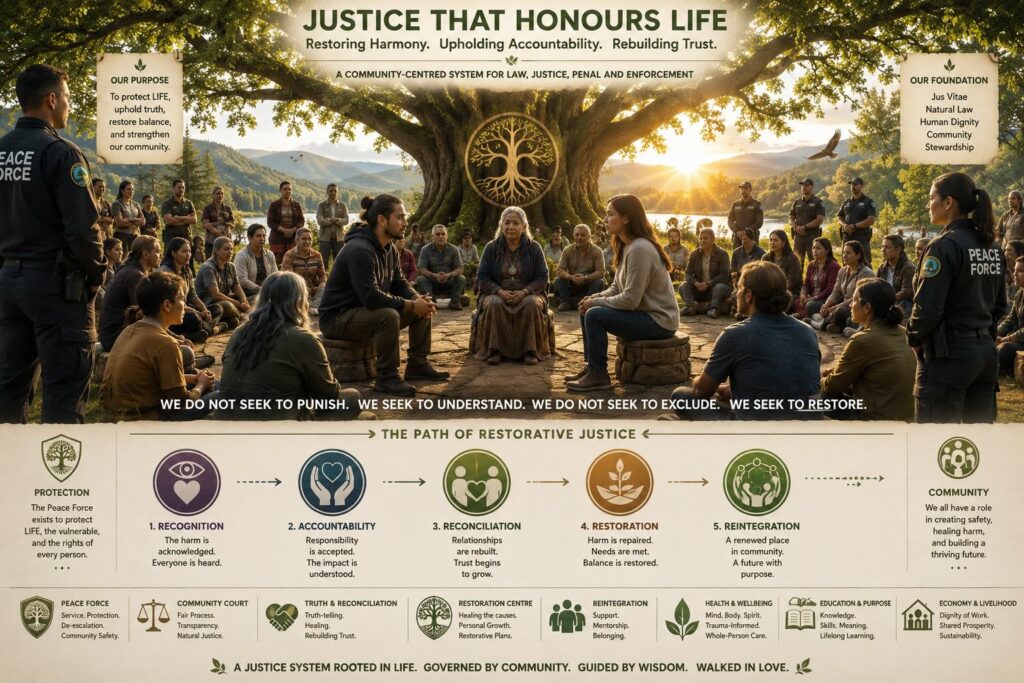
The Need For A Different Legal Framework
Modern legal systems often confuse order with peace. They may regulate behaviour, enforce compliance and administer punishment, yet still fail to heal the deeper conditions that create harm, fear and separation.
Governance4LIFE proposes a different foundation: a system rooted in LIFE, guided by truth, governed by community and measured by whether it protects dignity, freedom, wellbeing and the future of living beings.
The central question is: Does this honour LIFE?
The Four-Part Justice & Restoration Pathway
Peace Force
Truth & Reconciliation
Court of Jus Vitae
Restoration & Reintegration
1. Peace Force
The Peace Force exists to protect LIFE, safeguard the vulnerable, prevent harm and maintain community safety. Unlike conventional enforcement models, the Peace Force is founded upon service rather than domination.
The Peace Force exists to protect LIFE, not institutional power.
Protection
Safeguarding vulnerable people, preventing harm and responding to genuine threats to community safety.
De-escalation
Resolving conflict before it becomes violence, using calm presence, trained mediation and community trust.
Service
Serving the community through protection, assistance, emergency response and support.
Accountability
Upholding community decisions only when necessary and always in alignment with LIFE-honouring principles.
2. Truth & Reconciliation
When a grievance is reported, the preferred first response is a Truth & Reconciliation process. The objective is to understand what occurred, acknowledge harm and seek restoration wherever possible.
What happened? Who was harmed? What truth has been avoided? What accountability is required? What would begin to restore trust?
Recognition of Harm
The injured party is heard, harm is identified and immediate protection is provided when required.
Accountability
Facts are gathered, responsibility is examined and the impact upon people and community is understood.
Reconciliation
Where appropriate, facilitated dialogue, apology, restitution and restoration agreements may be developed.
Restoration
The focus is not winning a case, but restoring balance wherever possible.
3. Court of Jus Vitae
Not every dispute can be reconciled. Some matters involve serious harm. Others involve individuals unwilling or unable to participate in restoration. In these circumstances, the matter may proceed to a Court of Jus Vitae.
The Injured Party Doctrine
Where there is no victim, there is no crime. Where there is no harm, there is no law — only a rule.
Harm To An Individual
Direct injury to a living person: body, mind, liberty, dignity, safety or wellbeing.
Harm To Private Property
Damage, theft or destruction of what a person has legitimately built, grown, created, earned or been given.
Harm Through Deception
Fraud, coercion, dishonourable conduct or consent extracted through concealment or manipulation.
Harm To The Living Planet
Unnecessary harm to water, soil, air, ecosystems or the living systems upon which all communities depend.
Key Legal Distinctions
Malum In Se
Wrong in itself. An act inherently harmful by its nature, such as murder, abuse, fraud, exploitation or violation of dignity.
Malum Prohibitum
Wrong because prohibited. An act treated as wrong only because a rule says so, even where no living being has been harmed.
Legal / Illegal
Categories that measure compliance with statutes, regulations and administrative rules.
Lawful / Unlawful
Categories that measure whether an action honours or violates LIFE, natural law, dignity, consent and truth.
4. Restoration & Reintegration Centres
Where temporary separation from the community is necessary, the purpose is protection and restoration rather than punishment. A person who has caused harm is not viewed as an enemy to be discarded, but as someone whose relationship with LIFE has become incoherent and requires restoration.
Healing
Trauma-informed care, counselling, meditation, emotional support and Health4LIFE practices.
Education
Education4LIFE, literacy, life skills, conflict transformation and meaningful personal development.
Service
Food growing, repair of harm, community contribution and learning responsibility through action.
Purpose
Helping each person rediscover a constructive role within the wider community.
Reintegration Pathway
Reintegration is part of justice. When responsibility has been accepted, harm has been addressed and restoration has begun, the community should provide a pathway back into meaningful participation whenever reasonably possible.
While reconciliation is always preferred, the protection of LIFE remains paramount. Some individuals may be unwilling or unable to participate in restoration. In such cases, longer-term separation may be required until the risk to others has been addressed.
A Justice System Rooted In LIFE
Governance4LIFE does not seek to create a more efficient system of punishment. It seeks to create a more coherent system of protection, accountability, restoration and community wellbeing.
A justice system rooted in LIFE is governed by community, guided by wisdom, grounded in natural law, focused on restoration and measured by the protection of LIFE.