
Introduction
For over a century, global institutions, governments, and academic disciplines have advanced numerous definitions and strategies for achieving peace. Despite these efforts, persistent conflict, systemic inequality, and ecological instability suggest that peace remains largely aspirational rather than operational. A central limitation identified in this thesis is the absence of a shared, holistic, and measurable definition of peace, resulting in fragmented approaches and limited accountability.
This thesis introduces the Greenprint4LIFE (G4L) as a unifying framework designed to address this gap.
Redefining Peace
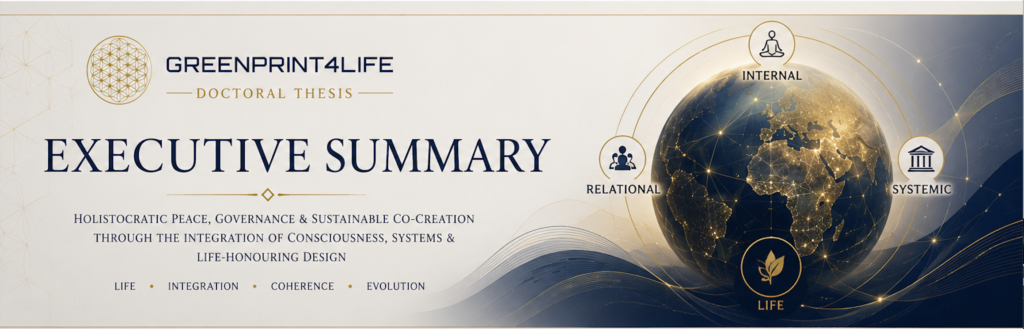
At its core, the Greenprint4LIFE redefines peace as a state of coherence with LIFE — a condition of alignment across three interconnected domains:
- Internal coherence
(psychological, emotional, and physiological regulation) - Relational coherence
(interpersonal and cultural dynamics) - Systemic coherence
(governance, economic, ecological, and institutional structures)
Rather than treating peace as an outcome of external negotiation alone, the G4L positions it as an emergent property of aligned systems operating across scales.
Systems Theory and Coherence
The framework draws upon interdisciplinary insights from systems theory, neuroscience, psychology, and complexity science, demonstrating that both individuals and societies exist within dynamic fields of possibility.
Within these fields, patterns of coherence increase stability, adaptability, and regenerative capacity, while incoherence contributes to fragmentation and systemic breakdown.
The Matrix4LIFE Model
To operationalize this understanding, the thesis introduces the Matrix4LIFE — an hourglass-structured model situated within a bi-directional systems architecture.
This model integrates a reverse-engineering approach to transformation with continuous feedback between individual development and systemic design.
Instead of attempting incremental reform from current conditions alone, communities define a desired future state — characterized by health, sustainability, and LIFE-honouring systems — and systematically work backward to identify the necessary conditions for its realization.
At the same time, the model recognizes that systemic conditions continuously influence patterns of individual and collective development, forming a recursive loop of co-evolution.
Integrated Transformation
The Greenprint4LIFE framework integrates:
- Individual transformation
(healing, self-awareness, and behavioral regulation) - Relational development
(trust-building, communication, and cultural alignment) - System design
(governance, economy, education, health, and infrastructure)
Through this integration, peace becomes both measurable and actionable, rather than abstract or symbolic.
Transformation is therefore understood not as a linear progression, but as a recursive and co-evolutionary process across interconnected domains.
Core Contribution of the Thesis
This thesis does not claim to introduce a new scientific paradigm.
Instead, its primary contribution is the synthesis of existing knowledge into a coherent, scalable architecture capable of guiding real-world transformation at the community level.
The Greenprint4LIFE serves as both a conceptual framework and a practical design tool for creating communities that are healthy, clean, green, and self-sustaining.
Closing Reflection
Ultimately, this work proposes that peace is not something to be achieved externally, but something to be designed, cultivated, and sustained through coherence with LIFE itself.
The framework presented in this thesis did not emerge solely through theoretical inquiry. It reflects over twenty years of longitudinal observation across educational systems, governance structures, institutional dynamics, and evolving patterns of human behaviour and collective development.
Peace, within this framework, is no longer understood as an abstract aspiration.
It becomes:
- a condition that can be defined
- a process that can be designed
- a reality that can be lived and sustained
When coherence is established across the systems that shape human experience, peace is no longer something to be continually negotiated as an external outcome.
It becomes something consciously lived and co-created through alignment with LIFE.
In 2006, a definition of peace rooted in humanity’s relationship to LIFE was proposed.
In 2026, a framework is presented through which that definition may begin to be operationalized.
The challenge was never solely in identifying what peace is.
The deeper challenge has been in creating systems capable of living it.