
Framework Comparisons:
How the G4L Relates to Other Models
Geoffrey West | Founder, Greenprint4LIFE | greenprint4life.earth
| Comparison | Status |
|---|---|
| G4L vs THRIVE Solutions Model — Foster & Kimberly Gamble | ● Published |
| G4L vs UBUNTU / One Small Town — Michael Tellinger | ● Published |
| G4L vs The Venus Project — Jacque Fresco & Roxanne Meadows | ● Published |
| G4L vs Auroville — Mirra Alfassa & Sri Aurobindo | ● Published |
| G4L vs Findhorn Ecovillage — Peter, Eileen Caddy & Dorothy Maclean | ● Published |
Click any comparison above to jump directly to that section.
A Full Comparative Assessment
Acknowledgment & Credit
The Greenprint4LIFE believes in supporting other initiatives and tries to give credit where it is due.
The G4L acknowledges, with gratitude and appreciation, the work of Foster and Kimberly Gamble and the team they have assembled, to provide the videos that have inspired millions. I personally have watched their videos, and I found them to be fantastic! They were fortunate to have the resources behind them, to be able to do their work and build a movement behind it, and they were especially fortunate to have each other.
The Greenprint4LIFE was not as fortunate. This framework was envisioned and built purely through my motivation and love for humanity and the planet. Where people dedicate 30 years to one or more companies, seeking a retirement pension, I spent 30+ years building this framework without an income or financing; a large, institutional debt and very little institutional support, as well as no public support of family and/or friends and without a female partner by my side. This was a soul-calling mission.
I offer to THRIVE and to Kimberly and Foster my congratulations for what they have built and what they have chosen to stand for. Thank you for your service!
The following comparison is offered so that people can understand the relationship between these two frameworks, and where the Greenprint4LIFE framework goes further.
G4L vs THRIVE Solutions Model
What They Share
What They Are, Fundamentally
The THRIVE Solutions Model is a movement organising toolkit. Thoughtfully designed, practically useful, and reaching a genuinely significant global audience through the THRIVE films, its 13-sector model gives communities a shared structure for coordinating action across domains. Its Solutions Hub provides infrastructure for groups worldwide to share best practices, match needs with resources, and amplify each other’s efforts. It is, at its best, a coordination platform — designed to mobilise and connect existing energy around existing knowledge.
The Greenprint4LIFE is a civilisational architecture. It is designed not to coordinate action around existing systems, but to provide the foundational definition, the generative frequency, the coherence framework, the community design blueprint, the economic drivers, and the governance model that make genuine transformation structurally possible rather than merely aspirationally intended.
The distinction is not one of scale or ambition. It is one of depth and foundation.
Eight Dimensions of Comparison
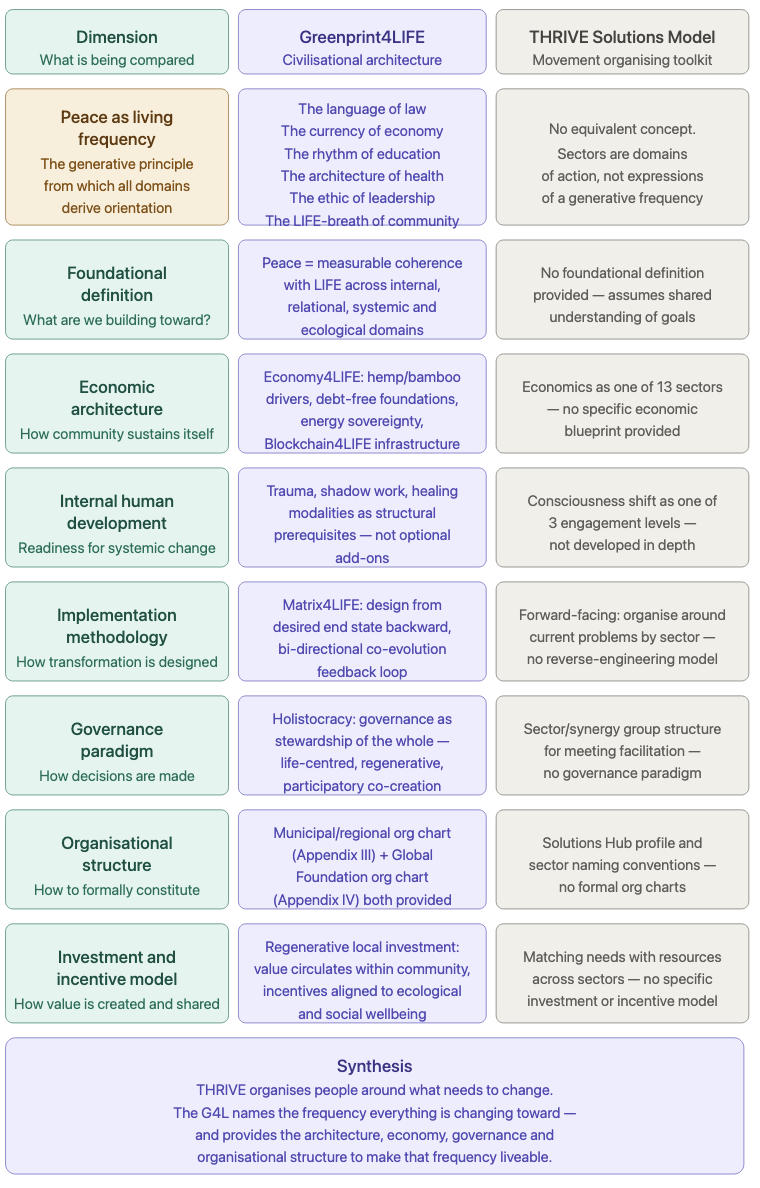
1 Peace as a Living Frequency — The Generative Principle
This is where the difference between the two frameworks is most profound, and where the Greenprint4LIFE stands entirely alone.
The THRIVE model identifies sectors of human activity that need to change. It organises people around what is wrong and what must be addressed. This is valuable — but it does not answer the deeper question: what is the frequency toward which everything is changing?
The Greenprint4LIFE answers that question precisely. Peace is not defined as the absence of conflict, nor as a political agreement, nor as an aspirational state. It is defined as a coherent frequency of alignment with LIFE itself — and that frequency, when lived collectively, expresses itself as:
The currency of economy
The rhythm of education
The architecture of health
The ethic of leadership
The LIFE-breath of community
These six expressions are not metaphors for alignment. Each word is chosen with precise intentionality. Law has a language because coherent law speaks the same truth at every scale. Economy has a currency because coherent economy circulates value the way living systems circulate energy. Education has a rhythm because coherent education moves with the natural unfolding of human potential. Health has an architecture because coherent health is designed into the environment, not merely treated after breakdown. Leadership has an ethic because coherent leadership derives its authority from service to LIFE, not from power over it. Community has a breath because coherent community is alive — it inhales the gifts of its members and exhales sustenance in return.
No comparable framework in the field of peace studies, systems design, or community architecture has named this frequency with this level of precision. The THRIVE model has no equivalent concept. Its sectors are domains of action. The G4L’s six expressions are domains of being — each one a recognisable frequency of what coherence actually feels like when a domain is living it.
The G4L is not a framework that happens to include a definition of peace. It is a framework in which peace as living frequency is the generative principle from which every pillar, every design choice, and every implementation pathway derives its orientation.
2 Foundational Definition of Peace
The THRIVE model assumes that people share an understanding of what they are working toward. It does not provide — because no existing framework has provided — a formally grounded, cross-disciplinary, holistic definition of peace as the foundational premise of community design.
The Greenprint4LIFE provides exactly that. Peace redefined not as the absence of conflict or a political outcome, but as a measurable state of coherence with LIFE — internal, relational, systemic, and ecological. This is not a philosophical flourish. It is the architectural foundation upon which every pillar of the framework rests. Without it, sector-based organising risks becoming what the thesis calls “adopting the language of transformation without the structural changes required to realise it.”
THRIVE organises people. The G4L gives them something precisely defined to organise toward.
3 Economic Architecture
The THRIVE model identifies Economics as one of its 13 sectors — a domain where communities coordinate action around economic issues. It points toward solutions without providing the specific economic architecture that would make a community genuinely self-sustaining and free from debt dependency.
The G4L’s Economy4LIFE pillar provides that architecture in full. It identifies specific regenerative economic drivers — hemp and bamboo as foundational engines, chosen deliberately for their ecological regenerativity and their historical suppression by the very systems the thesis diagnoses. It provides debt-free economic foundations, local self-sufficiency as a structural design outcome rather than an aspiration, energy sovereignty through geothermal and emerging technologies, and Blockchain4LIFE as the verification and distributed trust infrastructure that allows a community economy to function transparently without dependence on conventional banking structures.
Without this level of economic specificity, even the most well-organised community eventually gets pulled back into the systems it was attempting to transcend.
4 Internal Human Development as Prerequisite
The THRIVE model’s three levels of engagement — Immediate Needs, Systemic Change, and Consciousness Shift — acknowledge the internal dimension of transformation. But it remains an acknowledgment rather than a developed framework. The model does not provide the depth of understanding about why people don’t change, what trauma and conditioning do to perception and behaviour, and what healing processes are required before systemic change can take root and hold.
The G4L addresses this directly and at length. It treats trauma, shadow work, ego dynamics, addiction, and healing not as peripheral concerns but as the central reason systemic reform consistently fails without human integration. It integrates psychology, neuroscience, and somatic and frequency-based healing modalities into the community design framework. Internal coherence is not an optional add-on — it is a prerequisite for the community architecture to function.
THRIVE assumes a readiness that the G4L builds.
5 Reverse-Engineering Methodology
The THRIVE model organises communities around current problems — identifying what is wrong in each sector and coordinating action to address it. This is a forward-facing, problem-centred approach.
The G4L’s Matrix4LIFE reverse-engineering methodology inverts this entirely. Communities begin by defining a desired future state — characterised by health, coherence, sustainability, and LIFE-honouring systems — and then systematically work backward to identify the structural conditions necessary for its realisation. This is a fundamentally different orientation: it designs toward a destination rather than away from a problem. In complex systems terms, it is the difference between reactive management and generative design.
The hourglass structure of the Matrix4LIFE — with its bidirectional feedback between individual development and systemic design — also captures something the THRIVE model does not: that the relationship between personal transformation and systemic change is not linear but recursive. Each continuously shapes and is shaped by the other.
6 Governance Architecture
The THRIVE model provides a group facilitation structure — sector groups, synergy teams, whole group facilitators — that is functional and thoughtful for coordinating existing communities of interest.
The G4L introduces Holistocracy — a fully developed governance paradigm that addresses the foundational question of what governance is for. Governance as stewardship of the whole, grounded in life-centredness, interdependence, regeneration, participatory stewardship, and co-creation. This is not a meeting format. It is a governance philosophy with specific structural implications for how communities make decisions, resolve conflicts, manage resources, and remain accountable to their own stated values across time.
7 Organisational Structure
One of the most common failure points for visionary frameworks is the transition from compelling idea to actual implementation. The question every serious reader eventually asks is: where do I actually start, and how does the structure formally constitute itself?
The THRIVE model provides Solutions Hub profile creation and sector naming conventions — helpful for groups wanting to self-organise. It does not provide the organisational architecture that tells a community how to formally constitute itself, define roles, establish accountability structures, and connect local implementation to a broader global network.
The G4L addresses this directly through two specific deliverables: a Municipal and Regional Governance Organisation Structure providing the community-level blueprint, and a Global Foundation Organisation Structure providing the connective architecture between local communities and the broader movement. Together these allow individual G4L communities to be part of something larger without being controlled by it — entirely consistent with the framework’s non-dictatorial principle.
The G4L is not a movement waiting for an organisation. It is an organisation waiting for a movement to find it.
8 Investment and Incentive Model
The THRIVE model provides a matching of needs with resources across sectors — a useful coordination function. It does not provide a specific investment model or incentive architecture that ensures value created within a community remains within it and serves its members rather than extracting outward to external financial systems.
The G4L’s Economy4LIFE pillar and its regenerative community design ensure that incentives are structurally aligned to ecological and social wellbeing from the outset. Value circulates within the community the way nutrients circulate in a living ecosystem. The economic design is not an afterthought — it is integral to the coherence architecture from the first design decision.
Synthesis
The most honest way to frame this comparison is not as competition but as complementarity — at different levels of the same architecture.
THRIVE has built something genuinely valuable: a global network of people who have seen the films, understood the diagnosis, and are ready to act. It has the audience, the coordination infrastructure, and the cultural reach that years of grassroots organising produces.
The Greenprint4LIFE has built something the THRIVE model assumes but never fully provides: the foundational frequency, the operational definition, the economic blueprint, the human development framework, the community design architecture, the governance paradigm, and the organisational structure that gives all of that organised energy somewhere coherent, structurally sound, and deeply alive to go.
THRIVE organises people around what needs to change.
The G4L names the frequency everything is changing toward —
and provides the architecture, economy, governance, and organisational structure to make that frequency liveable.
Together, they would be something considerably more powerful than either is alone.
The Greenprint4LIFE doctoral thesis and five-part article series on peace are available at greenprint4life.earth
A Full Comparative Assessment
Acknowledgment & Credit
The Greenprint4LIFE believes in supporting other initiatives and tries to give credit where it is due.
The G4L acknowledges, with genuine respect, the work of Michael Tellinger and the UBUNTU / One Small Town movement. Michael’s courage in confronting the financial enslavement at the root of human suffering, and his commitment to building something better rather than simply opposing what exists, reflects a spirit that the Greenprint4LIFE deeply honours. His use of Buckminster Fuller’s principle — build a new model that makes the existing one obsolete — is one that the G4L shares entirely.
It is also worth acknowledging honestly that the One Small Town pilot in North Frontenac, Ontario did not succeed as intended. The initiative fizzled — not because the vision was wrong, but because vision without structural architecture beneath it depends on political goodwill, and political goodwill is not a foundation. When the wind changed, there was nothing structural to hold the initiative in place.
This is not offered as a criticism of Michael’s work. It is offered as a data point — and as the precise reason why the Greenprint4LIFE goes further. Good intentions and a contributionist economic model are necessary. They are not sufficient. What is also required is a foundational definition of what the community is moving toward, a human development prerequisite framework, a governance architecture that does not depend on existing political structures, and a community design that holds its coherence regardless of who holds office.
I offer to Michael Tellinger my sincere respect for what he has attempted, and my hope that the Greenprint4LIFE framework can provide the architectural foundation that future UBUNTU-inspired communities will need to make the vision sustainable beyond a single sympathetic mayor.
The following comparison is offered so that people can understand the relationship between these two frameworks, and where the Greenprint4LIFE framework goes further.
G4L vs UBUNTU / One Small Town
What They Share
What They Are, Fundamentally
The UBUNTU / One Small Town model is a contributionist community activation strategy. Grounded in the ancient African philosophy that “I am because we are,” it proposes that communities can build genuine abundance by having each resident contribute a small number of hours per week — approximately three — to collectively owned community projects. Over time, these projects generate surpluses that reduce the community’s dependence on money, employment, and external systems. The model works within existing municipal structures, relying on a sympathetic mayor and council to initiate and champion the process.
The Greenprint4LIFE is a civilisational architecture. It is designed not merely to activate community contribution, but to provide the foundational definition of what the community is moving toward, the governance paradigm through which decisions are made, the human development prerequisites that determine whether residents are ready for genuine transformation, and the full economic, educational, health, and ecological design of a community that can sustain its coherence across time — regardless of who holds political office.
The distinction is not one of intent. Both intend liberation. It is one of structural depth and self-sustaining architecture.
Nine Dimensions of Comparison
1 Peace as a Living Frequency — The Generative Principle
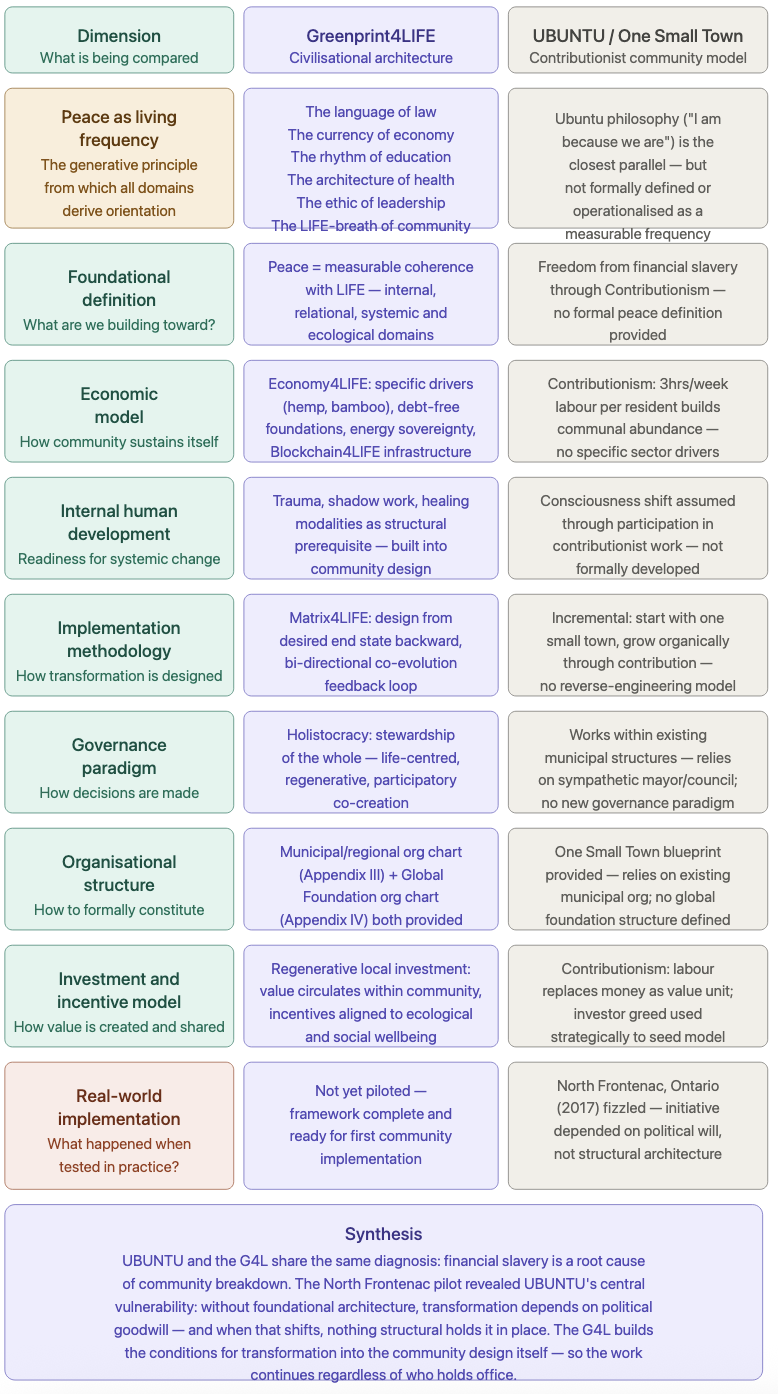
The UBUNTU model is animated by a genuine and beautiful philosophy — the African principle of Ubuntu, which holds that a person is a person through other persons, that individual flourishing and collective flourishing are inseparable. This is a profound and ancient truth. However, Ubuntu as a philosophy is not operationalised as a measurable frequency within the One Small Town model. It is the inspiration behind the model, not its architectural foundation.
The Greenprint4LIFE goes further. Peace is defined not as a political outcome, not as the absence of conflict, and not as a philosophical orientation — but as a coherent frequency of alignment with LIFE itself, expressed across every domain of community life:
The currency of economy
The rhythm of education
The architecture of health
The ethic of leadership
The LIFE-breath of community
These six expressions give communities a precise and measurable orientation — not just a spirit to embody, but a frequency to design toward. The Ubuntu philosophy points in the same direction. The G4L names the destination with architectural precision.
2 Foundational Definition
The UBUNTU / One Small Town model is founded on a definition of the problem — financial slavery — rather than a definition of the destination. It knows what it is moving away from with great clarity. What it is moving toward is described in terms of abundance, freedom, and collective wellbeing — aspirational and genuine, but not formally defined as a measurable state.
The Greenprint4LIFE provides that formal definition. Peace as a measurable state of coherence with LIFE — internal, relational, systemic, and ecological. This gives communities not just a direction but a destination they can assess their progress toward, adjust their design around, and hold themselves accountable to across time.
UBUNTU knows what it is escaping. The G4L defines precisely where it is going.
3 Economic Model
The UBUNTU contributionist model is one of the most creative economic proposals of the contemporary alternative movement. The idea that three hours of skilled contribution per week from each resident can, over time, produce genuine community abundance is elegant and grounded in real mathematics of collective productivity. Michael Tellinger’s insight that the “greed of investors” can be strategically used to seed the model — using the tools of enslavement as tools of liberation — is both pragmatic and sophisticated.
The G4L’s Economy4LIFE pillar builds on this spirit while providing greater architectural specificity. It identifies specific regenerative economic drivers — hemp and bamboo as foundational engines — chosen for their ecological regenerativity and their historical suppression by the very systems that profit from community dependency. It provides debt-free economic foundations designed into the community from the outset, energy sovereignty through geothermal and emerging technologies, and Blockchain4LIFE as the distributed verification and trust infrastructure that allows the community economy to function transparently without conventional banking dependency.
Where UBUNTU proposes that communities can build their way out of financial slavery through collective contribution, the G4L designs the economic architecture that makes that liberation structurally durable rather than dependent on ongoing goodwill and participation rates.
4 Internal Human Development as Prerequisite
The UBUNTU model assumes that participation in contributionist work will itself shift consciousness — that working together toward collective abundance produces the internal transformation that deeper community requires. There is genuine truth in this. Shared meaningful work does change people. The model, however, does not formally address why people resist transformation even when its benefits are clear, what trauma and conditioning do to collective coherence, or what healing processes are required before a community can sustain genuine cooperation through difficulty.
The G4L treats this dimension as a structural prerequisite rather than an assumed outcome. Trauma, shadow work, ego dynamics, addiction, and healing modalities are integrated into the community design framework — not as therapeutic add-ons but as the foundation without which even the most well-designed economic model will fracture under the pressure of human complexity. Internal coherence is not something that emerges from good systems. Good systems emerge from internal coherence. That sequence matters enormously for implementation.
UBUNTU trusts that good work transforms people. The G4L prepares people so they can sustain good work.
5 Implementation Methodology
The One Small Town methodology is incremental and organic. It begins where communities are — with existing residents, existing infrastructure, and an existing municipal structure — and builds gradually through growing participation in contributionist projects. This is its greatest practical strength: it does not require a complete redesign of the community before beginning. It asks only that a mayor, a council, and a willing group of residents say yes and start.
The G4L’s Matrix4LIFE reverse-engineering methodology takes a different approach. Rather than building incrementally from current conditions, communities begin by defining a desired future state — characterised by health, coherence, sustainability, and LIFE-honouring systems — and then systematically work backward to identify the structural conditions necessary for its realisation. This is the difference between reactive management and generative design. It is also what allows the G4L to produce communities that are structurally coherent from the outset, rather than discovering structural gaps after years of incremental work.
The two methodologies are not mutually exclusive. An UBUNTU-activated community that has begun building contributionist projects could adopt the G4L’s reverse-engineering framework to give its emerging architecture a coherent long-term destination — ensuring that the incremental work builds toward something structurally complete.
6 Governance Architecture
The One Small Town model works within existing municipal governance structures. This is simultaneously its most practical feature and its most significant vulnerability. A sympathetic mayor and a unanimous council vote — as happened in North Frontenac, Ontario — can launch the process. But the same political structure that enables the launch can also, when personnel or priorities change, withdraw the support that the initiative depends on. When governance depends on political goodwill rather than structural design, the initiative is only as durable as the next election cycle.
The North Frontenac pilot confirmed this precisely. The initiative fizzled not because Contributionism is wrong, but because it had no governance architecture of its own that could hold the community’s coherence independent of political change.
The G4L’s Holistocracy addresses this directly. Governance as stewardship of the whole — grounded in life-centredness, regeneration, and participatory co-creation — is a governance paradigm that does not depend on existing political structures for its legitimacy or continuity. It is designed to hold community coherence across personnel changes, political cycles, and external pressures. This is not a philosophical preference. It is a structural necessity for any community serious about long-term transformation.
7 Organisational Structure
The One Small Town model provides a community activation blueprint and relies on existing municipal organisational structures to carry implementation forward. It does not provide formal organisational charts for either community-level governance or a global foundation network that connects individual communities to a broader movement without controlling them.
The G4L addresses both levels explicitly. A Municipal and Regional Governance Organisation Structure provides the community-level blueprint — answering the question of who does what, how roles are defined, how accountability is maintained, and how the community constitutes itself formally. A Global Foundation Organisation Structure provides the connective architecture between communities and the broader G4L movement — allowing communities to be part of something larger while remaining self-governing and non-dictated. This dual architecture is what allows the G4L to scale without becoming the centralised system it was designed to replace.
8 Investment and Incentive Model
The UBUNTU contributionist model proposes that investor greed can be used strategically to seed community projects — investors receive returns while the community builds toward the point where external investment is no longer needed. This is genuinely clever. It meets the current system where it is and uses its own mechanisms to fund its eventual transcendence.
The G4L’s Economy4LIFE pillar ensures that investment incentives are structurally aligned to ecological and social wellbeing from the outset — not as a transitional strategy but as a permanent design principle. Value circulates within the community the way nutrients circulate in a living ecosystem. The regenerative local investment model ensures that the community is not dependent on external capital for its ongoing function, removing the leverage that external investors could otherwise use to redirect community priorities toward financial rather than coherence-based outcomes.
9 Real-World Implementation Outcome
The One Small Town model has the distinction of having been formally adopted by an elected mayor — Ron Higgins of North Frontenac, Ontario — who received unanimous council support for the initiative in 2017. That real-world adoption is something the G4L has not yet achieved, and it is worth acknowledging as a genuine strength of the UBUNTU model’s accessibility and practical appeal.
However, the North Frontenac initiative subsequently fizzled. Local reporting confirmed the initiative had not sustained itself, with commentators noting that it had depended on a specific political moment that did not hold. The council’s openness, while commendable, was not a structural foundation. When the momentum shifted, the initiative had no self-sustaining architecture beneath it to maintain its direction.
This outcome is not an indictment of Michael Tellinger’s vision. It is precisely the kind of real-world data point that the G4L’s thesis diagnoses as the systemic pattern: initiatives that adopt the language of transformation without the structural architecture required to sustain it will not hold when conditions change. The G4L has not yet been piloted — but when it is, the governance architecture, the human development prerequisites, and the community design will not depend on the political willingness of any single mayor. They will be built into the structure of the community itself.
Synthesis
UBUNTU / One Small Town and the Greenprint4LIFE share the same diagnosis: financial slavery is a root cause of human suffering and community breakdown, and the path forward is to build new systems rather than reform broken ones. Michael Tellinger’s courage and creativity in developing and promoting Contributionism over fifteen years deserves genuine recognition.
The North Frontenac pilot revealed UBUNTU’s central structural vulnerability: without foundational architecture, transformation depends on political goodwill — and when that shifts, nothing structural holds the initiative in place. This is not a failure of vision. It is a failure of foundation.
The Greenprint4LIFE builds the conditions for transformation into the community design itself — the foundational peace frequency, the human development prerequisites, the reverse-engineering methodology, the Holistocracy governance paradigm, and the dual organisational structure — so that the work continues regardless of who holds office, what external pressures arise, or how political winds shift.
UBUNTU knows what it is escaping.
The G4L defines precisely where it is going —
and builds the architecture to make the journey self-sustaining.
Together, a UBUNTU-activated community with the G4L’s architectural foundation beneath it would be something considerably more durable than either model alone.
The Greenprint4LIFE doctoral thesis and five-part article series on peace are available at greenprint4life.earth
A Full Comparative Assessment
Acknowledgment & Credit
The Greenprint4LIFE believes in supporting other initiatives and tries to give credit where it is due.
The G4L acknowledges, with deep respect, the extraordinary lifework of Jacque Fresco and Roxanne Meadows. Jacque Fresco spent more than seventy years developing a vision for a world in which human beings are free from scarcity, debt, and the systemic violence of monetary systems — a world in which science and technology serve humanity rather than extract from it. That dedication, sustained across a lifetime and largely outside the mainstream, deserves genuine recognition. Few visionaries have been as consistent, as detailed, or as courageous in naming what is wrong with the current civilisational model and proposing something genuinely different.
The Venus Project inspired millions through the Zeitgeist film series and continues to represent one of the most ambitious civilisational redesign proposals ever articulated. Its Resource Based Economy framework remains a landmark contribution to the conversation about what comes after the monetary system — and Jacque Fresco’s architectural designs for future communities are among the most beautiful expressions of what human ingenuity could create in service of life.
The Greenprint4LIFE was not built with the resources, the partnership, or the institutional platform that The Venus Project eventually developed. It was built by one person, without income or financing, across three decades, out of the same conviction that drove Fresco: that the current system is not a permanent feature of reality, and that something genuinely better is not only possible but necessary.
I offer to the memory of Jacque Fresco, and to Roxanne Meadows who continues the work, my deepest admiration for what they dared to imagine and dedicate their lives to building.
The following comparison is offered so that people can understand the relationship between these two frameworks, and where the Greenprint4LIFE framework goes further.
G4L vs The Venus Project
What They Share
What They Are, Fundamentally
The Venus Project is a global civilisational redesign proposal. It proposes a Resource Based Economy in which all goods and services are available to all people without the need for money, credits, barter, or any other means of exchange. All resources are declared the common heritage of Earth’s inhabitants. Science and technology — particularly automation and cybernated resource management — replace monetary systems and political governance as the mechanisms through which human needs are met and decisions are made. It is explicitly global in scope, requiring planetary-scale coordination and technological deployment before it can function as intended.
The Greenprint4LIFE is a community-level civilisational architecture. It does not require global resource declaration or planetary technological infrastructure before a community can begin. It proposes that peace — defined as a measurable state of coherence with LIFE — can be designed into communities at the scale where human beings actually live, beginning with individual transformation and scaling upward through fractal coherence to community, regional, and eventually planetary levels.
Both are attempting civilisational transformation. The Venus Project begins at the top of the system and works down. The Greenprint4LIFE begins at the level of the human being and the community, and works outward.
Eight Dimensions of Comparison
1 Peace as a Living Frequency — The Generative Principle
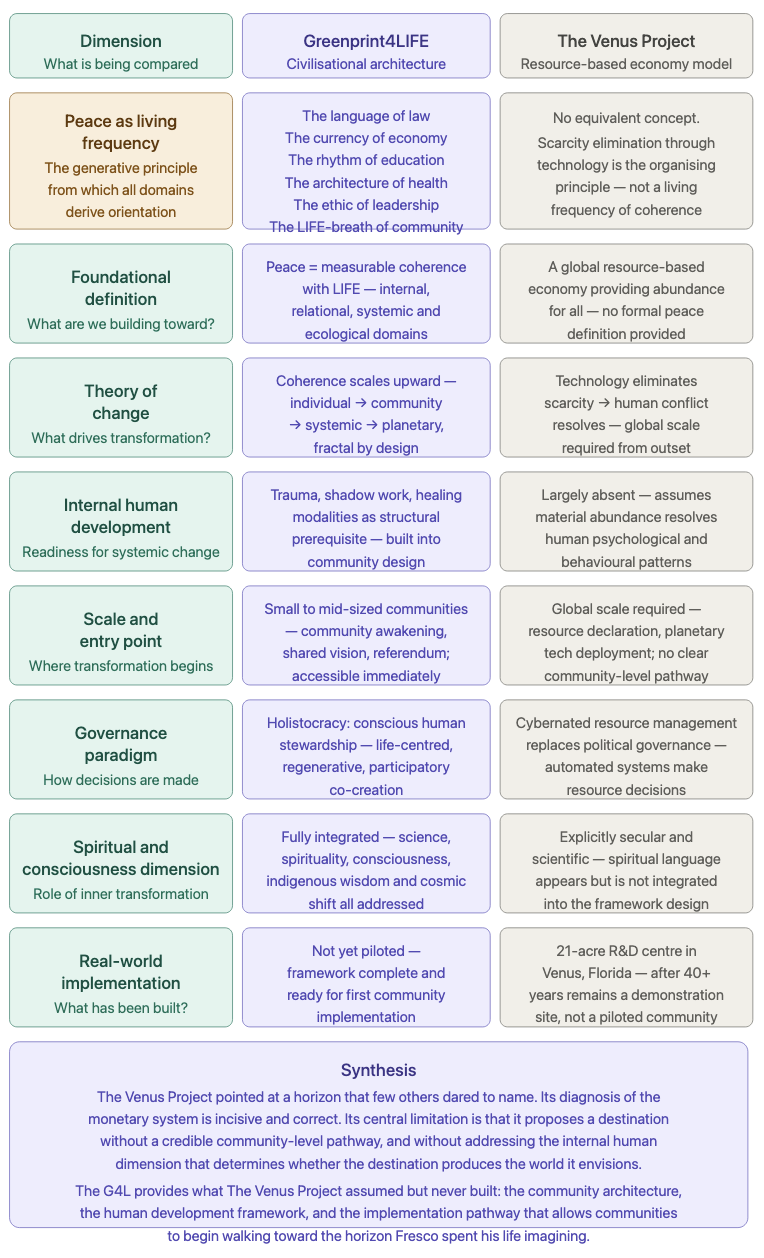
The Venus Project’s organising principle is the elimination of scarcity through the intelligent management of Earth’s resources. This is a profoundly important goal — and its diagnosis of how artificial scarcity is maintained by monetary systems is incisive and correct. However, the elimination of scarcity is not itself a definition of peace. It is a necessary condition. It is not sufficient.
The Greenprint4LIFE provides what The Venus Project does not: a precise definition of what the destination actually is — and a name for the frequency toward which all transformation is moving. Peace is not the absence of scarcity. It is a coherent frequency of alignment with LIFE itself, expressed across every domain of community existence:
The currency of economy
The rhythm of education
The architecture of health
The ethic of leadership
The LIFE-breath of community
These six expressions give any community — regardless of whether it has access to planetary-scale technological infrastructure — a precise and measurable orientation for its design. The Venus Project describes the material conditions that would make peace more possible. The G4L names the frequency that peace actually is, and provides the architecture for communities to begin living it now rather than after global transformation has been achieved.
2 Foundational Definition
The Venus Project is founded on a definition of the problem — scarcity maintained by monetary systems — rather than a formal definition of the destination. It describes the destination in terms of abundance, equality, sustainability, and freedom from servitude. These are genuine and important values. They are not, however, a formally defined, cross-disciplinary, measurable state that communities can assess their progress toward.
The Greenprint4LIFE provides that formal definition. Peace as a measurable state of coherence with LIFE — internal, relational, systemic, and ecological — gives communities not just a direction but a destination they can design toward, assess their progress within, and hold themselves accountable to across time and through changing circumstances.
The Venus Project knows what humanity is escaping. The G4L defines precisely where it is going — and provides the map for getting there at the scale where human beings actually live.
3 Theory of Change
The Venus Project’s theory of change is fundamentally top-down and global. It proposes that when planetary resources are declared common heritage, when cybernated systems manage their distribution equitably, and when automation eliminates the need for drudge labour, the material conditions for human flourishing will exist and human conflict and suffering will correspondingly diminish.
The G4L’s theory of change is fundamentally fractal and community-level. Coherence scales upward — from the healed individual to the coherent community to the aligned governance structure to the regenerative economy to the ecologically integrated civilization. This does not require global political consensus, planetary resource declaration, or technological infrastructure that does not yet exist before a community can begin.
The fractal coherence model also means that each G4L community that achieves coherence becomes a living demonstration of what is possible — far more persuasive to neighbouring communities and the broader world than any blueprint, film, or proposal, however brilliant.
4 Internal Human Development as Prerequisite
The Venus Project is a profoundly materialist framework. It proposes that if the material conditions of human life are redesigned — if scarcity is eliminated, if automation removes drudge labour, if resources are equitably distributed — human beings will naturally express their highest potential. The internal human dimension — trauma, conditioning, shadow, the psychology of power, and the question of why people reproduce destructive patterns even when material conditions improve — is largely absent from the framework’s architecture.
History offers sobering evidence for why this matters. Revolutionary movements that redesigned material conditions without addressing internal human development consistently reproduced the dynamics they replaced. New systems were captured by old patterns — because the humans within them had not done the internal work that genuine transformation requires.
The G4L treats this dimension as a structural prerequisite. Trauma, shadow work, ego dynamics, addiction, and healing modalities are not peripheral concerns — they are the central reason systemic reform consistently fails without human integration.
The Venus Project trusts that better conditions will produce better people. The G4L prepares better people to create and sustain better conditions.
5 Scale and Entry Point
The Venus Project requires global scale to function as intended. After more than forty years, the 21-acre research centre in Venus, Florida remains a demonstration site. The pathway from a demonstration site to a global Resource Based Economy has never been articulated with sufficient specificity to be actionable.
The G4L is explicitly designed for small to mid-sized communities. It does not require the surrounding world to change before a community can begin. A community can begin this process with whatever it currently has, wherever it currently is, and whatever level of external support it currently receives.
6 Governance Architecture
The Venus Project proposes replacing political governance with cybernated resource management — automated systems that make resource allocation decisions based on scientific data. This removes corruption and ideology from governance. It also removes human agency, cultural diversity, spiritual values, and the irreducible complexity of what communities need beyond resource management.
The G4L’s Holistocracy is a fully developed governance paradigm built around conscious human stewardship of the whole — life-centred, regenerative, and participatory. It does not automate human decision-making. It transforms the quality of human consciousness and institutional design so that decisions emerge from coherence, wisdom, and service to LIFE rather than from fear, scarcity, and ego.
7 Spiritual and Consciousness Dimensions
The Venus Project is explicitly secular and scientific. This grounded the framework in measurable principles — and left largely unaddressed the dimensions of human experience that science does not yet fully measure: consciousness, meaning, spiritual connection, and the cosmic dimensions of the planetary shift currently underway.
The Greenprint4LIFE integrates the scientific and the spiritual without apology. Peace as a coherent frequency of alignment with LIFE is simultaneously a systems concept and a spiritual one. The framework draws on neuroscience, epigenetics, and complexity science in the same breath as indigenous wisdom, the emerging science of consciousness, and the cosmic dimensions of humanity’s current evolutionary moment.
8 Real-World Implementation
The Venus Project has maintained a research and development centre in Venus, Florida since 1980. After more than forty years, the project remains a demonstration site rather than a piloted community. The gap between the 21-acre centre and a functioning Resource Based Economy has not been bridged — because the framework requires preconditions that have not yet been created at the global scale the model requires.
The G4L has not yet been piloted either. But its implementation pathway does not depend on global preconditions. A community can begin the G4L process this year, with existing residents, in an existing location, using existing resources as its starting point.
Synthesis
The Venus Project pointed at a horizon that few others dared to name — a world without scarcity, without monetary enslavement, without the manufactured conflicts that keep humanity from its highest expression. Jacque Fresco’s seventy-year dedication to that vision deserves profound respect.
The Venus Project’s central limitation is that it proposes a global destination without a community-level pathway, and without adequately addressing the internal human dimension that would determine whether the destination, once reached, would actually produce the world it envisions.
The Greenprint4LIFE does not replace The Venus Project’s vision. It provides what that vision assumed but never built: the community-scale architecture, the human development prerequisites, the consciousness-based governance model, the spiritual integration, and the implementation pathway that allows communities to begin living toward the world Fresco spent his life imagining — not after global transformation, but as the seed of it.
The Venus Project pointed at the horizon.
The G4L draws the map of how to begin walking toward it —
one community, one conscious choice, one coherent design at a time.
The Greenprint4LIFE doctoral thesis and five-part article series on peace are available at greenprint4life.earth
A Full Comparative Assessment
Acknowledgment & Credit
The Greenprint4LIFE believes in supporting other initiatives and tries to give credit where it is due.
Auroville deserves a form of acknowledgment that none of the other comparisons on this page require — because Auroville is not a proposal or a blueprint. It is a living community that has existed for 57 years, housing approximately 3,500 residents from over 50 nations, producing remarkable ecological restoration, educational innovation, cultural richness, and a genuinely unique experiment in human unity. That is not a small thing. That is an extraordinary achievement, and it deserves to be named as such before any comparison is offered.
The vision of Sri Aurobindo and Mirra Alfassa — that humanity can realise a divine consciousness on Earth, that a community can be built around inner development rather than material accumulation, and that human unity is not merely an aspiration but a structural possibility — resonates deeply with the foundational frequency of the Greenprint4LIFE. These are not competing visions. They are expressions of the same underlying understanding of what humanity is capable of.
It is also important to acknowledge honestly that Auroville is currently in crisis. Since 2021, an external governing board appointed by the Indian government has systematically dismantled the participatory governance structures that Auroville operated under for more than thirty years. In 2025, the Supreme Court of India ruled that residents have no legal right to participate in their own governance. This is not a minor administrative dispute. It is the precise failure mode that the Greenprint4LIFE’s architectural design was built to prevent.
This comparison is offered not as a criticism of Auroville’s vision, which remains one of the most inspiring experiments in conscious community ever undertaken. It is offered as an honest examination of what 57 years of lived experience reveals about what a visionary community needs — structurally, not just spiritually — to sustain its founding intention across time, across leadership changes, and against external pressure.
The Greenprint4LIFE honours Auroville’s extraordinary journey and offers its architectural framework as a response to the lessons that journey has made available to the world.
G4L vs Auroville
What They Share
What They Are, Fundamentally
Auroville is a spiritually founded intentional community — one of the longest-running experiments in conscious community living in the modern era. Founded in 1968 by Mirra Alfassa, based on the transformative vision of Sri Aurobindo, it was conceived as a place where human beings from all nations could live in conscious pursuit of human unity and the realisation of a higher consciousness. Over 57 years it has produced extraordinary ecological achievement, educational innovation, and cultural expression. It now anchors over 50 bioregional community development initiatives across environment, education, health, social enterprise, and cultural preservation.
The Greenprint4LIFE is a community-level civilisational architecture — not yet a lived community, but a fully developed framework designed precisely to address the structural vulnerabilities that Auroville’s history has revealed. Auroville has lived the experiment, achieved much of what the G4L aspires toward, and encountered — in its current crisis — exactly the failure mode the G4L’s architecture was designed to prevent.
Auroville is the proof of concept that visionary community is possible. The G4L’s architecture is the structural response to what that proof of concept has also revealed about what such communities need in order to protect their founding vision across generations.
Nine Dimensions of Comparison
1 Peace as a Living Frequency — The Generative Principle
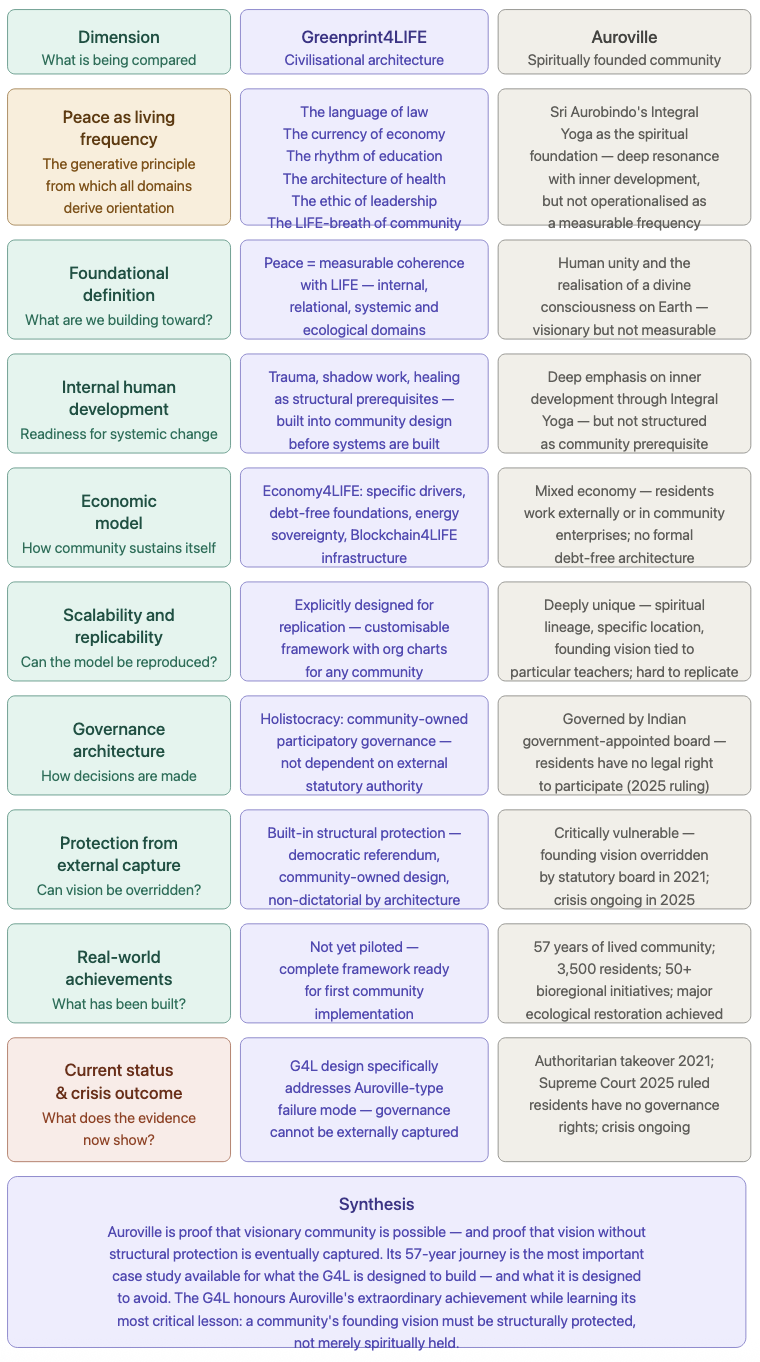
Sri Aurobindo’s vision of the supramental consciousness — a higher frequency of being that transforms not just the mind but the body and the material world — is the most profound parallel to the G4L’s concept of peace as a living frequency that exists anywhere in the comparative landscape of this page. Both understand that what is being sought is not a political arrangement or a material condition, but a state of being that expresses itself through every dimension of human life.
The distinction is one of operationalisation. Sri Aurobindo’s vision is articulated in the language of Integral Yoga — profound, transformative, and deeply personal. The G4L’s peace frequency is articulated in the language of community architecture:
The currency of economy
The rhythm of education
The architecture of health
The ethic of leadership
The LIFE-breath of community
These six expressions are not a replacement for the spiritual depth that Auroville embodies. They are a translation of that depth into structural terms — giving communities a precise and measurable orientation that can be designed into governance, economy, education, and health systems, rather than depending on individual practitioners of Integral Yoga to embody it person by person. The G4L and Auroville are pointing at the same destination. The G4L provides a structural map for communities that do not have a living Master to guide them.
2 Foundational Definition
Auroville’s founding charter describes it as a place “where men and women of all countries are able to live in peace and progressive harmony, above all creeds, all politics and all nationalities” — a beautiful and genuinely visionary statement. It is a description of an atmosphere rather than a measurable architectural destination. It tells community members what life should feel like. It does not provide the structural definition of what coherence is, how it is assessed, and what specific design choices produce or undermine it.
The Greenprint4LIFE provides that formal definition. Peace as a measurable state of coherence with LIFE — internal, relational, systemic, and ecological. This gives communities a destination they can assess their progress toward, adjust their design around, and hold themselves accountable to — regardless of whether a spiritual master is present to embody the vision.
Auroville holds the spirit of the destination. The G4L provides the structural map for reaching it.
3 Internal Human Development
Of all the frameworks compared on this page, Auroville takes the internal human dimension most seriously. Sri Aurobindo’s Integral Yoga is a comprehensive path of inner transformation — physical, vital, mental, and spiritual — and Auroville was conceived as a place where that transformation could be pursued collectively, in the context of a living community rather than an individual retreat. This is its greatest strength and its most distinctive contribution to the understanding of what conscious community requires.
The G4L’s approach to internal human development is structurally similar in its insistence that inner transformation is a prerequisite for outer coherence — but it is grounded in the accessible language of contemporary psychology, neuroscience, trauma healing, and shadow work, rather than in a specific spiritual lineage. This makes it accessible to communities that are not oriented around Integral Yoga or any particular spiritual path, while preserving the same foundational understanding: that systems cannot be more coherent than the people within them.
4 Economic Model
Auroville operates on a mixed economy in which residents work in community enterprises, external businesses, or receive support from an internal maintenance allocation. This has allowed the community to function for over half a century, but it has not produced full economic self-sufficiency or freedom from external financial dependency.
The G4L’s Economy4LIFE pillar is designed to produce structural economic self-sufficiency from the outset. Specific regenerative economic drivers — hemp and bamboo as foundational engines — provide a tangible, locally controllable economic base. Debt-free economic foundations, energy sovereignty, and Blockchain4LIFE infrastructure ensure that the community’s economic functioning is not dependent on external banking systems, investor goodwill, or the continued supply of external resources.
5 Scalability and Replicability
Auroville is deeply and beautifully unique. Its founding vision is tied to a specific spiritual lineage, a specific location in southern India, and the extraordinary charisma and authority of its founders. These qualities are part of what makes Auroville what it is — and part of what makes it almost impossible to replicate. There is only one Auroville.
The G4L is explicitly designed for replication. It is a customisable framework that any community can adopt, adapt, and make its own. It does not depend on a specific spiritual lineage, a specific location, or a charismatic founder’s ongoing authority. The founding principles are preserved; the implementation is always locally owned.
6 Governance Architecture
This is where Auroville’s history offers its most important lesson — and where the G4L’s architecture most directly responds to it.
Auroville’s governance structure was always vulnerable to external statutory override. The Auroville Foundation Act of 1988 created a Governing Board appointed by the Indian government — a structure that coexisted peacefully with community self-governance for over three decades because the individuals appointed respected the community’s founding principles. When that personal respect was withdrawn in 2021, the statutory structure allowed an externally appointed board to systematically dismantle the participatory governance that Auroville had operated under for fifty years.
In 2025, the Supreme Court of India confirmed that residents have no legal right to participate in their own governance. The founding vision of human unity and participatory community has been legally overridden by a statutory framework that the community did not design and cannot remove.
The G4L’s Holistocracy is specifically designed to prevent this failure mode. Community governance is owned by the community — constituted through democratic referendum, protected by the community’s own legal and structural architecture, and not dependent on external statutory authorities for its legitimacy or continuity. The community is the authority.
7 Protection from External Capture
The Auroville crisis of 2021–2025 is the most important contemporary case study in the vulnerability of visionary communities to external institutional capture. A community of 3,500 people, with 57 years of extraordinary achievement, has been unable to protect its own governance from an externally appointed board. The residents have been legally ruled to have no governance rights.
This is the predictable outcome of building a visionary community on a spiritual foundation without also building the structural and legal architecture that protects that vision from the systems it was designed to transcend. Good intentions, spiritual depth, and decades of genuine achievement are not, by themselves, protection against institutional capture.
The G4L’s architecture responds to this directly. Every design choice — from the democratic referendum process to the community-owned governance structure to the economic self-sufficiency model — is oriented toward ensuring that the community’s founding vision cannot be overridden by any external authority, statutory or otherwise.
8 Real-World Achievements
Here the comparison must be stated plainly and with genuine respect: Auroville has achieved what the G4L has not yet had the opportunity to attempt. Fifty-seven years of lived community, ecological restoration of what was once a barren plateau into a thriving forest, educational approaches that have influenced progressive pedagogy globally, healthcare systems that integrate conventional and traditional medicine, cultural production of extraordinary richness, and the lived demonstration that human beings from more than fifty nations can share a community oriented around inner development and human unity.
These achievements are the most powerful argument available for the possibility of what the G4L proposes. Auroville exists. It has proven that the vision is not utopian. The G4L framework, when it finds its first community, will be building on a foundation of proof that Auroville has provided across five decades.
9 Current Status and Crisis Outcome
As of 2025, Auroville is facing what its own community describes as the greatest governance crisis in its 56-year history. The consolidation of authoritarian control through judicial backing, plans for paramilitary deployment, and systematic institutional appropriation have threatened the community’s foundational commitments to sustainable living and human unity. The Supreme Court’s ruling that residents have no governance rights has effectively placed a community built on participatory human unity under the legal authority of an externally appointed board.
This outcome confirms, with 57 years of accumulated evidence, what the G4L’s thesis diagnoses: that vision without structural protection will eventually encounter the systems it was designed to transcend — and when it does, spirit alone is not sufficient protection.
The G4L has not yet been piloted. When it is, the Auroville crisis will have served as one of its most important design teachers.
Synthesis
Auroville is simultaneously the most inspiring and the most instructive of all the frameworks compared on this page. It is the most inspiring because it exists — because 57 years of lived community, ecological achievement, and genuine human unity have proven that the vision the G4L proposes is not utopian. It is the most instructive because its current crisis has confirmed, with the full weight of five decades of evidence, what the G4L’s architecture was designed to address: a community’s founding vision must be structurally protected, not merely spiritually held.
The Indian government’s statutory override of Auroville’s participatory governance is not a failure of Auroville’s vision. It is a failure of Auroville’s structural architecture — specifically, its dependence on an external statutory framework for its governance legitimacy. The G4L’s Holistocracy, its democratic referendum process, its community-owned legal and organisational structure, and its economic self-sufficiency model are all direct architectural responses to the failure mode that Auroville’s history has revealed.
The Greenprint4LIFE does not position itself as superior to Auroville. It positions itself as the structural response to what Auroville’s extraordinary journey has taught the world about what conscious community needs in order to survive — and thrive — across generations, leadership changes, and external pressure.
Auroville proved that the vision is possible.
The G4L builds the structural architecture to protect it —
so that what Auroville built across 57 years
can never be taken away.
The Greenprint4LIFE doctoral thesis and five-part article series on peace are available at greenprint4life.earth
A Full Comparative Assessment
Acknowledgment & Credit
The Greenprint4LIFE believes in supporting other initiatives and tries to give credit where it is due.
Of all the communities and frameworks compared on this page, Findhorn is the one whose founding spirit comes closest to the heart of what the Greenprint4LIFE aspires to build. Founded in 1962 by Peter Caddy, Eileen Caddy, and Dorothy Maclean on the principles of co-creation with nature, inner listening, and love in action, Findhorn has spent 61 years demonstrating that a community can be genuinely built around spiritual practice, ecological integrity, and human unity — and that this is not a romantic ideal but a lived, documented, and internationally recognised reality.
The community has been designated a UN-Habitat Best Practice model for holistic and sustainable living — recognised in 1998 and re-designated in 2018. Its ecological footprint is approximately half the UK average. Its wind turbines have enabled net electricity export since the early 2000s. It is home to the Global Ecovillage Network, linking over 6,000 ecological communities around the world. It hosts thousands of visitors annually from over 50 countries. And in 2025, after facing significant challenges, it is actively regenerating and rerooting in its founding principles — a testament to the resilience of a community built on something deeper than material interest.
Academic research has identified four fractal patterns of social innovation running through Findhorn across six decades: ecological regeneration, solidarity economy, reflexive governance, and — perhaps most significantly — spirituality as public ethics. That last phrase is one of the most resonant descriptions of what the Greenprint4LIFE itself aspires toward that exists anywhere in the academic literature. These are not competing visions. They are expressions of the same understanding.
The Greenprint4LIFE was built by one person, without institutional support or financial security, across three decades — carrying a conviction similar to the one that brought three people to a caravan park in northeast Scotland in 1962 and refused to leave. That kinship of spirit is real, and it is worth naming before any comparative analysis begins.
I offer to the Findhorn community, and to all those who have built and sustained it across 61 years, my deepest respect and gratitude for what they have proven is possible. The G4L is, in many ways, the architectural response to the question that Findhorn has spent six decades answering in lived form.
The following comparison is offered so that people can understand the relationship between these two frameworks, and where the Greenprint4LIFE framework goes further.
G4L vs Findhorn Ecovillage
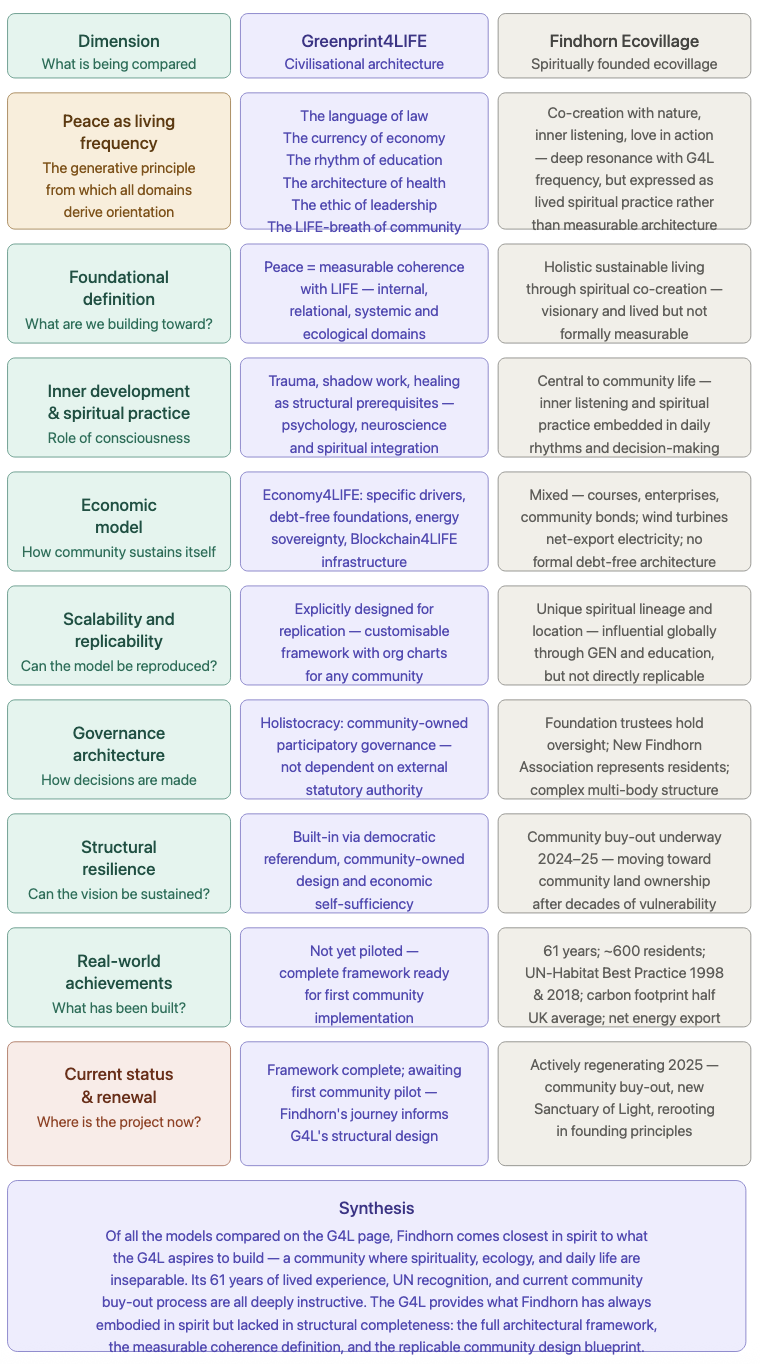
What They Share
What They Are, Fundamentally
The Findhorn Ecovillage is a spiritually founded intentional community and global learning centre. Built around three core principles — co-creation with nature, inner listening, and love in action — it has grown from three people in a caravan park to a community of approximately 600 residents from 25 countries, surrounded by regenerating native forest, organic gardens, and renewable energy systems. It is simultaneously a living community, a global centre for transformational education, and the home of the Global Ecovillage Network. Its 61 years represent the longest continuous experiment in spiritually grounded ecological community in the Western world.
The Greenprint4LIFE is a community-level civilisational architecture — a complete, replicable framework designed to translate the spirit that Findhorn has lived for six decades into a structural blueprint that any community can adopt, regardless of whether it has Findhorn’s specific spiritual lineage, founding figures, or geographic particularity. Where Findhorn demonstrates that conscious community is possible, the G4L provides the architectural design that makes it structurally reproducible and resilient.
The relationship between them is not one of competition. It is one of lived proof and structural response. Findhorn proved the vision. The G4L designs the architecture to protect and replicate it.
Nine Dimensions of Comparison
1 Peace as a Living Frequency — The Generative Principle
Findhorn’s three founding principles — co-creation with nature, inner listening, and love in action — are among the most beautifully articulated expressions of what the G4L calls the peace frequency that exist in any living community. Co-creation with nature is the ecological dimension of coherence with LIFE. Inner listening is the internal dimension — the practice of aligning individual awareness with something deeper than personal preference or fear. Love in action is the relational dimension — coherence expressed through service, care, and genuine presence with others.
The Greenprint4LIFE names this same frequency in the language of community architecture:
The currency of economy
The rhythm of education
The architecture of health
The ethic of leadership
The LIFE-breath of community
These six expressions do not replace Findhorn’s three principles. They translate them into structural terms — giving communities a precise, measurable orientation for designing governance, economy, education, and health systems, rather than depending on individual practitioners of inner listening and co-creation to embody them person by person. Findhorn and the G4L are pointing at exactly the same frequency. The G4L provides the architectural blueprint for communities that do not yet have Findhorn’s 61 years of lived wisdom to guide them.
2 Foundational Definition
Findhorn’s founding vision is articulated as a lived spiritual practice rather than a formally measurable state. The community knows what it is moving toward — human unity, ecological co-creation, spiritual awakening — but has not articulated this as a cross-disciplinary, assessable architectural destination. Over 61 years, this has produced extraordinary depth of lived experience. It has also meant that the community’s coherence has depended significantly on the ongoing presence of individuals deeply committed to the founding principles — and has faced real challenges when that personal commitment has wavered or when external pressures have increased.
The Greenprint4LIFE provides the formal definition that Findhorn embodies but has not fully articulated. Peace as a measurable state of coherence with LIFE — internal, relational, systemic, and ecological — gives communities a destination they can design toward, assess their progress within, and hold themselves accountable to, independent of any particular individual’s spiritual commitment at any given moment.
Findhorn lives the frequency. The G4L names it in structural terms so that it can be designed, assessed, and protected.
3 Inner Development and Spiritual Practice
This is where Findhorn most clearly goes further than any other framework compared on this page — including the G4L’s current form. Inner listening as a daily practice, embedded in the community’s decision-making processes, its relationship with nature, its educational work, and its governance culture, represents sixty years of accumulated wisdom about what it actually means to align human systems with a deeper intelligence than the rational mind alone. The Findhorn Foundation’s programmes have influenced thousands of practitioners worldwide. The community’s relationship with the devic realm, with the intelligence of plants and ecosystems, and with the subtle dimensions of co-creation represent a body of experiential knowledge that no written framework can fully capture.
The G4L’s approach to internal human development — trauma healing, shadow work, somatic integration, neuroscience-grounded coherence practices — is accessible, cross-cultural, and clinically grounded. It reaches communities that may not be oriented toward Findhorn’s specific spiritual vocabulary. What it does not yet have is Findhorn’s depth of accumulated lived wisdom about what inner listening in community actually looks, feels, and produces over decades.
This is an area where the G4L would be genuinely enriched by collaboration with Findhorn — not as a dependency, but as a deepening. The structural architecture the G4L provides and the lived spiritual wisdom Findhorn has accumulated across six decades are genuinely complementary.
4 Economic Model
Findhorn’s economy is mixed and pragmatic — residents work in community enterprises, external employment, and educational programmes. The community’s wind turbines have achieved net electricity export since the early 2000s, demonstrating genuine energy sovereignty at the community scale. A community bond issue in 2024 raised £400,000 to begin the process of bringing land and buildings into community ownership — a significant step toward the economic self-sufficiency that the founding vision always implied but that structural circumstances had previously prevented.
The G4L’s Economy4LIFE pillar designs this outcome into the community from the outset — specific regenerative economic drivers, debt-free foundations, energy sovereignty, and Blockchain4LIFE infrastructure — so that the community’s economic functioning is self-sustaining by design rather than achieved incrementally over six decades. Findhorn’s journey toward community land ownership, arrived at after 61 years, is where the G4L begins.
5 Scalability and Replicability
Findhorn is deeply rooted in its specific location, its founding spiritual lineage, and the extraordinary presence of its founding figures. These are inseparable from what Findhorn is — and from what makes it almost impossible to replicate precisely. There is one Findhorn. Its influence has spread globally through the Global Ecovillage Network, through its educational programmes, and through the thousands of people who have passed through it and carried its principles into the world. But that influence operates through inspiration and learning, not through a replicable structural blueprint.
The G4L is designed from the outset for replication. It does not depend on a specific location, a founding spiritual lineage, or charismatic founding figures. It provides the structural architecture — governance, economy, education, health, ecology, and technology — that any community can adopt, adapt to its own context, and implement through a democratic referendum process. The G4L aspires to be what Findhorn has inspired but never provided: a replicable design that allows the principles Findhorn embodies to be lived by communities that did not grow up within Findhorn’s specific tradition.
6 Governance Architecture
Findhorn’s governance is layered and complex — the Findhorn Foundation trustees hold ultimate oversight, the New Findhorn Association represents the broader resident community, and multiple organisations with different legal structures operate within the wider ecovillage. This complexity has reflected the organic growth of the community across six decades, and has allowed significant flexibility and responsiveness. It has also created ongoing tensions between different bodies, contributed to the vulnerabilities that led to recent crises, and made decision-making processes slower and less transparent than the community’s founding principles would ideally require.
The current community buy-out process — creating a community benefit society to bring land and buildings into direct community ownership — represents a significant move toward the kind of governance architecture the G4L’s Holistocracy designs from the outset. Findhorn is arriving, after 61 years, at a structural position the G4L begins with: community ownership of the physical and governance infrastructure that makes the community’s founding vision structurally protected rather than dependent on the goodwill of external trustees.
7 Structural Resilience
Findhorn’s resilience has been tested repeatedly — through the passing of its founding figures, through financial crises, through a devastating fire in 2021, and through governance disputes that have at times threatened the community’s coherence. That it has survived and is currently regenerating is a testament to the depth of the community’s commitment to its founding principles. It is also evidence that resilience built on spiritual commitment and community bonds, without equally strong structural and economic architecture, requires constant renewal and faces recurring vulnerability.
The G4L’s structural resilience is designed in rather than grown over time. The democratic referendum process, the community-owned governance structure, the economic self-sufficiency model, and the Holistocracy governance paradigm collectively ensure that the community’s founding vision does not depend on any single individual’s commitment or any external body’s goodwill. The architecture holds the vision, so that the people within it can focus on living it rather than defending it.
8 Real-World Achievements
Findhorn’s achievements across 61 years are extraordinary and deserve full acknowledgment. An ecological footprint approximately half the UK average. Net electricity export through community-owned wind turbines. Organic agriculture and regenerating native forest on what was once barren duneland. UN-Habitat Best Practice recognition twice over. A global educational influence through the Findhorn Foundation’s programmes. The hosting of the Global Ecovillage Network, connecting over 6,000 communities worldwide. A community of 600 people from 25 nations living in genuine commitment to inner development, ecological integrity, and human unity.
These achievements are, again, the most powerful available argument for the possibility of what the G4L proposes. Findhorn has proven that a community oriented around spiritual practice, ecological co-creation, and human unity can exist, produce genuine wellbeing, and sustain itself across generations. The G4L framework, when it finds its first community, will be building on proof that Findhorn has provided across six decades.
9 Current Status and Renewal
In 2025, Findhorn is in active regeneration. Following the challenges of recent years — including the 2021 fire, governance disputes, and financial pressures — the community is rerooting in its founding principles of co-creation with nature, deep inner listening, and love in action. The Easter 2025 opening of the new Sanctuary of Light — a sacred space at the centre of community life — marked a symbolic moment of renewal. The community benefit society formed in 2024 is progressing with the community buy-out, raising funds and bringing buildings into collective ownership. International support has grown, and the community’s spirit of regeneration is genuine.
This timing makes the Findhorn comparison particularly significant for the G4L. A community in active renewal, rethinking its structural foundations, reconnecting with its founding vision, and moving toward the community ownership model it always needed — is a community that may be more open than at any previous moment to the kind of architectural framework the G4L provides. The G4L does not offer Findhorn a replacement for what it has built. It offers the structural blueprint that could make everything Findhorn has built permanently protected, structurally self-sustaining, and replicable by communities worldwide.
Synthesis
Of all the models compared on this page, Findhorn is the one that has spent the longest time closest to the G4L’s own vision — and the one from which the G4L has the most to learn and the most to offer in return.
Findhorn has proven across 61 years that a community built on spiritual practice, ecological co-creation, and human unity is genuinely possible. Its UN-Habitat recognition, its ecological achievements, its global educational influence, and its current spirit of regeneration are all testament to the depth and durability of its founding principles. The G4L honours this fully.
What the G4L provides that Findhorn has always embodied in spirit but not fully achieved in structure is the complete architectural blueprint — the measurable coherence definition, the formal governance framework, the economic self-sufficiency model, the replicable community design, and the global foundation structure — that makes the Findhorn vision permanently protected, structurally self-sustaining, and available to any community in the world that is ready to live it.
Findhorn is not a cautionary tale. It is a proof of concept and a living teacher. The G4L’s deepest hope is not to replace what Findhorn has built, but to ensure that what Findhorn has built across six decades of extraordinary human effort can never again be threatened by the structural vulnerabilities that recurring crises have revealed.
Findhorn has lived the frequency for 61 years.
The G4L provides the structural architecture to protect it —
and to make it available to every community
ready to live it.
The Greenprint4LIFE doctoral thesis and five-part article series on peace are available at greenprint4life.earth
greenprint4life.earth